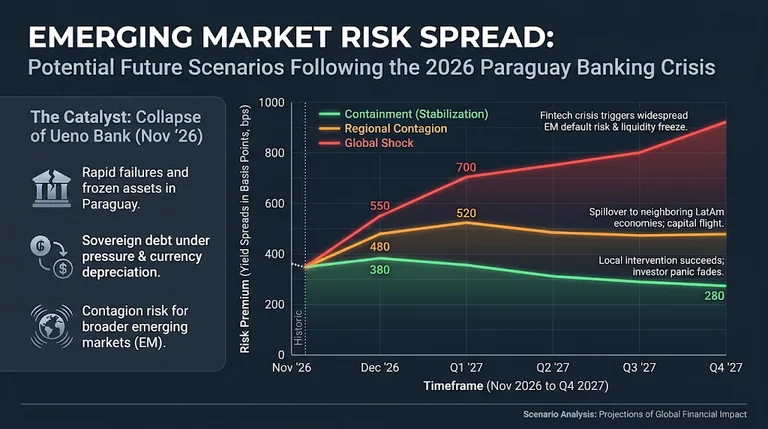
On 3 November 2026, the sudden collapse of Paraguay’s digital lender Ueno Bank triggered an unprecedented domestic shock, freezing the assets of millions and culminating in the rapid impeachment of President Santiago Peña. What initially appeared as a localized financial and political scandal is now echoing through global financial markets. The crisis perfectly illustrates a long-held fear among macroeconomic analysts: a seemingly small, isolated issue can act as the catalyst that triggers the destabilization of vulnerable economies across the globe.
Emerging market contagion and the fragility of investor confidence
The global financial system operates on an intricate web of trust and perceived stability. Paraguay was previously marketed as a beacon of economic reliability in Latin America, making the sudden exposure of deep-seated corruption and regulatory forbearance highly alarming for international investors. When a structural failure of this nature occurs, risk assessment algorithms and institutional investors do not merely penalize the offending nation. Instead, they broadly re-evaluate their exposure to similar emerging markets. This contagion effect means that a localized banking failure can quickly drain foreign direct investment and portfolio capital from other developing nations that are already struggling with high debt burdens or fragile fiscal policies.
Currency shocks and the repricing of sovereign debt
The immediate financial market reaction demonstrated how swiftly localized panic translates into regional vulnerability. Following the central bank intervention, Paraguayan sovereign bond spreads widened significantly, and the local currency suffered steep depreciation against the US dollar. In the interconnected world of foreign exchange, currency traders often use regional proxies to hedge or speculate against risk. Consequently, doubts regarding central bank independence in Paraguay have begun to weigh on the currencies of much larger economies. If investors suspect that other central banks in the developing world might also harbor hidden political liabilities, it could force preemptive interest rate hikes to defend falling currencies, stifling economic growth and increasing the likelihood of sovereign defaults in countries already operating on the brink.
Digital banking and the exposure of global systemic risks
Beyond sovereign debt and currency markets, the Ueno Bank meltdown serves as a massive stress test for the global fintech sector. The bank achieved its massive scale by rapidly acquiring customers with high-yield promises while circumventing mature risk controls. For global financial markets, this exposes a severe systemic risk inherent in the digital banking boom. Fast-growing digital lenders in emerging markets are achieving systemically important status long before they implement robust corporate governance. As a result, international markets are now aggressively repricing the risk associated with digital-first banks, threatening to tighten global liquidity and dry up funding for financial startups worldwide. The collapse in Asunción proves that in a hyper-connected era, the failure of a single vulnerable institution is more than enough to send shockwaves through the broader global economy.
Strategic recommendations for global entrepreneurs
In an interconnected financial landscape where a localized banking failure can rapidly drain international liquidity, entrepreneurs must proactively defend their capital structures. The primary directive is the aggressive diversification of capital allocation. Business leaders must avoid concentrating their operational funds in single institutions, particularly high-yield digital lenders operating in regulatory gray areas. Prudent treasury management now dictates spreading liquid balances across multiple tier-one banks in diverse jurisdictions, ensuring that a sudden freeze in one market does not halt daily operations.
Furthermore, active currency hedging is no longer optional for businesses operating across borders. Because isolated sovereign shocks can trigger widespread regional currency depreciation, companies exposed to emerging market foreign exchange must employ forward contracts and options. Locking in exchange rates will insulate profit margins from the erratic repricing of sovereign risk that follows these sudden institutional collapses.
Finally, entrepreneurs must conduct rigorous third-party risk assessments and prioritize strict corporate governance over aggressive yield. It is not enough to secure your own financial foundation; businesses must audit their supply chains and key vendors to ensure those partners are not over-exposed to fragile financial institutions. While the high interest rates offered by fast-growing fintechs are tempting for scaling startups, the return of principal is vastly more critical than the return on investment. Founders must demand transparency, mature risk controls, and proven regulatory compliance from all their financial partners to survive sudden macroeconomic tremors.